Linking verbs that describe changes

Linking verbs

We can use becomegetgo and turn as a linking verb. These types of linking verbs connect the subject of the verb to an adjective and describe changes.   
  • She hoped to become popular. 
  • I'm already starting to go bald. 
  • My work is getting better. 
  • The leaves are turning brown. 


Become and get can be used to describe changes of emotional or physical state, or situation. We use become in formal cases. 
  • He wants to become/get involved in politics. 
  • She became/got pregnant after two months.  

We use get with adjectives such as old, cold or dark to describe natural changes. 
  • It gets dark very early in the winter. 
  • We're all getting older every day. 

Go is used especially to describe changes that are not desirable 
  • My grandfather is going deaf. 
  • He went blind in one eye.  
  • He went crazy and started to scream.  
  • The milk has gone/turned sour. 
  • The bananas are starting to go rotten. 

Turn can be also used with an adjective to mean 'become' or 'change into a different state or condition'. 
  • The weather is turning cold. 
  • He turned nasty when I refused to give him another loan.  

We can use both turn and go to describe changes of colour. 
I started to turn/go gray when I was thirty. 
His face turned/went red with embarrassment 
She suddenly turned/went pale. 

Grammar Cards

Linking verbs

Linking verbs

Linking verbs

Comments

Popular posts from this blog

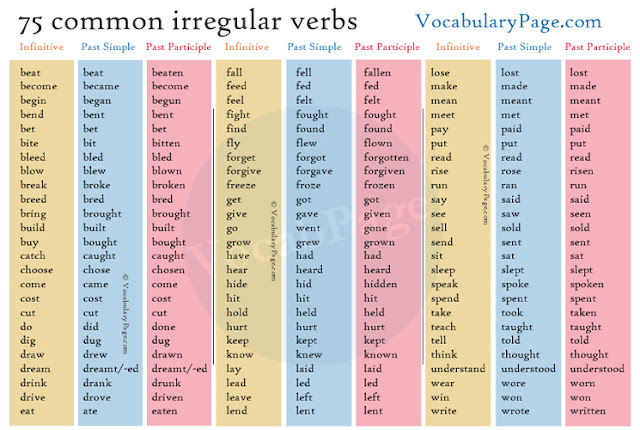
List of irregular verbs

In English, verbs can be regular or irregular .   

Colors in English

'What's your  favorite   color ?', 'What  color  are your eyes?' or 'What  color  is the car?' - these are the most common questions about  color  in English.  If you know the names of the  colors  in English, you will answer those questions .   Here is the list of the most common  colors :  

Nouns

The simplest definition of a noun is that it is a word that refers to a person (such as John or teacher), thing (such as ball or table), place (such as Harvard or university), or idea (such as love or emotion). What is a Noun? Countable Nouns and Uncountable nouns Some nouns can be counted and they are called countable nouns. Some nouns cannot be counted and they are called uncountable nouns.  Common Nouns and Proper Nouns Names of people, places, and things are called proper nouns. They always begin with capital letters. All other nouns are common nouns.  noncount-nouns.html Collective Nouns Words such as family, team or bunch are collective nouns. They can be used with either a singular or a plural verb. Abstract and Concrete Nouns If your five physical senses (sight, smell, hearing, taste, and touch) cannot detect something, it is an abstract noun.  Gender-specific nouns In some languages, nouns refer to specifically to males or females....