Posts

Expect, Hope or Wait?

These three words, Expect , Hope and Wait , are often confusing for learners of English. But they all have different meanings.  

This, that, these and those

This , that , these and those are demonstrative pronouns.  We use them  to point  to   specific people or things.   Demonstrative pronouns are used in place of a noun.  We can use same words as demonstrative adjectives. Demonstrative adjectives are used before a noun.

Emigrate vs Immigrate

The verbs  emigrate ,  with  an e ,  and  immigrate , with an  i , are often confused.  These two words,  emigrate and immigrate, have the general meaning 'to move from one country to another'.  They also sound very similar, but  the re   is a difference in meaning between these two verbs.  

Interrogative pronouns

Interrogative pronouns are used in asking questions. These words in English  are also known as wh-words because they include the same two letters – Wh . Interrogative pronouns are: what, when, where, who, whom, which, whose, why and  h o w .   

How to use either/or and neither/nor

The pairs  either...or  and neither...nor are correlative conjunctions . They connect words, phrases or clauses that are grammatically similar.    

Ad or Add?

A lot of  people often get confused about add and ad . These two words have same pronunciations, but they are spelled differently (add with two D's) and  have different meanings.   

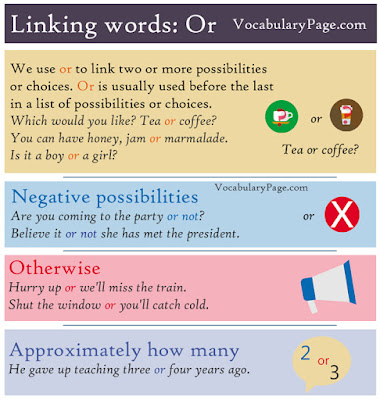
The conjunction Or

We use  or  to link two or more possibilities or  choices .   Or  is usually used before the last in a list of possibilities or choices.   Which would you like? Tea  or  coffee?   You can have honey, jam  or  marmalade.   Is it a boy  or  a girl?  

Adverbs of definite frequency

Adverbs of frequency describe how often something happens . There are two types of adverbs of frequency:     D efinite : We exactly know how often something happens, and use them at the end of a sentence.   I ndefinite : We do not know how often something happens, and use them  before the main verb, after the modal verb or first auxiliary verb, or after the verb to be.   Here   is  the list of  some  adverbs of definite frequency with examples:  

Linking verbs that describe changes

We can use  b ecome ,  get ,  go  and  turn  as a   linking verb . These types of  linking verbs  connect the subject of the verb to an adjective and  describe  changes.     She hoped to  become popular .   I'm already starting to  go bald .   My work is  getting better .   The leaves are  turning brown .  

Device or Devise?

Lots of people are mixing up device and devise . These   t wo words     look similar , but they have different  pronunciations and   meanings.   

How to use but as a conjunction

But  is a coordinating conjunction. You use  but  to join two ideas   or statements . The second idea or statement  usually contrasts the first one in some way.   Main  idea   +but +  Contrast