Posts

Indefinite pronouns (-body, -one, -thing, -where)

An indefinite pronoun is a pronoun that does not refer to any particular person, thing or place.   The indefinite  pronouns   ending  in  –body, –one,  - thing and -where   are used  to refer  to people, things, and places  when you do not know who or what they are .   They are written as one word .   Note that no one is written as two separate words .

Types of machine: Vocabulary

Here are the types of machine with example sentences. Washing machine   = f or washing clothes, sheets, etc.   Did you put the dirty clothes in the washing machine?   We'll send a plumber to install your washing machine.   I clean my washing machine once a month.   My new washing machine is more efficient than the old one.  

Adjectives: rich vs wealthy

The words rich and wealthy are actually synonyms. Both are often used when you are describing a person or place that has a lot of money and possessions. However, in some cases, only rich is possible. She is a very rich/wealthy woman. He was fabulously rich / wealthy . This is a rich / wealthy area. We always use rich in some fixed expressions such as stinking rich and filthy rich . They must be stinking/filthy rich. They must be stinking/filthy wealthy.

Adjectives used as nouns

As you kno w, adjectives and nouns are different parts of speech. A noun is a word that refers to a person, animal, thing, or idea, and an adjective describes a noun. For example, in the phrase 'a clever boy', 'clever' is an adjective, and 'boy' is a noun. In English, some adjectives can function as nouns. These are adjectival nouns.

Compound adjectives

In English, some adjectives can consist of two or more words. These are compound adjectives. Compound adjectives are usually written with hyphens when they are used in front of a noun they modify. For example, in the phrase ‘ man-eating lion’, ‘man-eating’ is a compound adjective. ‘Man eating lion’ means something different. As you can see, a hyphen changes the meaning of a phrase. Here are some examples of compound adjectives: She has a well-behaved child. He is a good-looking young man. It’s sugar-free chewing gum. They are long-distance lorry drivers. If a compound noun comes after the noun, it can drop the hyphen. a well-balanced diet The team was very well balanced . Compound adjectives can be formed with periods of time. We’ll take a ten-minute break. There has been a two-hour delay. I was on a two-year contract. We don’t add a plural ending to the compound adjectives with periods of time. We’re going on a six-days trip . … a si...

Close or Shut?

You can use the verbs close and shut to mean the same thing, but shut is less formal than close. Shut is an irregular verb. Its past tense and past participle forms are the same as the present tense. to shut – he shuts – he shut – he has shut

Altar vs Alter

The words altar and alter often confuse students because they are homophones.T hese words have the same pronunciation even though they are different parts of speech. Altar (with an A) is a noun. Alter (with an E) is a verb.

Fair vs Fare

Words that are pronounced the same often confuse the learners of English. These words are homophones. Homophones sound the same but have different meanings, origins or spellings. Fair and fare are two commonly confused words in English because they are homophones. Fair and fare are both pronounced as /feÉ™(r) / .

Formation of adjectives

There are no rules to help you recognize adjectives by their forms. But many adjectives are formed from other words by adding prefixes or suffixes.

Order of adjectives

An adjective is a word that describes a noun. In the phrase red car , red is an adjective. Sometimes we use several adjectives to describe a noun. Example: a small, red, German car. When we use more than one adjective before a noun, the adjectives need to be in a particular order. Most native speakers simply do it naturally. If you want your English to sound more natural, you must use the adjectives in the proper order.

The comparative and the superlative

Some adjectives describe the qualities of a noun, for example tall, long, expensive. These are qualitative adjectives. Qualitative adjectives have three forms; the positive, the comparative and the superlative. Positive Comparative Superlative big bigger biggest slow slower slowest difficult more difficult most difficult Comparative adjectives A comparative adjective is used to express a difference between two things. For example, bigger is the comparative form of big . We use the comparative when we want to compare two nouns. The preposition than is used after a comparative adjective in order to introduce the second part of a comparison. He needs stronger painkilling drugs. I'm trying to find a better job. He’s older than me. My daughter is taller than my wife. He was more intelligent than his brother. Superlative adjectives A superlative adjective expresses the greatest degree...

Price or Prize?

Price and prize are t wo commonly confused words in English. Although they look and sound very similar, their meanings are very different. Price and prize are both nouns. Price is pronounced with an 'S' sound, while  prize is pronounced with a 'Z' sound. Price /prais/ and prize /praiz/.

Borrow and Lend

For many learners of English, borrow and lend are two confusing verbs. Both words have a difference in meaning. If you give something to someone, you lend it; if you take and use something from someone, you borrow it.

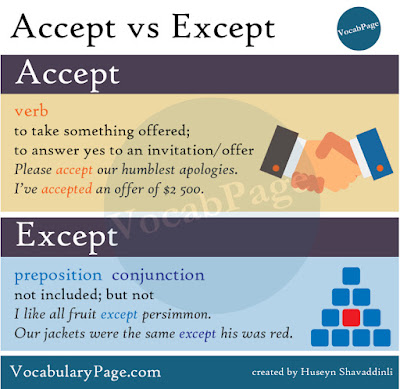
Accept and Except

Although the words accept and except sound very similar, they’re quite different in meaning. Accept is a verb. It means to take something offered; to answer yes to an invitation or offer. Except is most commonly used as a preposition.

Compound nouns

A compound noun is a noun that consists of two or more different words. Most compound nouns are formed by combining two nouns or an adjective and a noun. Toothpaste (noun+noun) is an example of a compound that combines two nouns. Greenhouse (adjective+noun) is a combination of an adjective and a noun.

Gender-specific nouns

In many languages, the gender of nouns is divided into three categories; masculine, feminine and neuter. Male people and animals belong to the masculine gender (e.g. boy, son, or uncle) and female people and animals belong to the feminine gender (e.g. girl, daughter, or aunt).